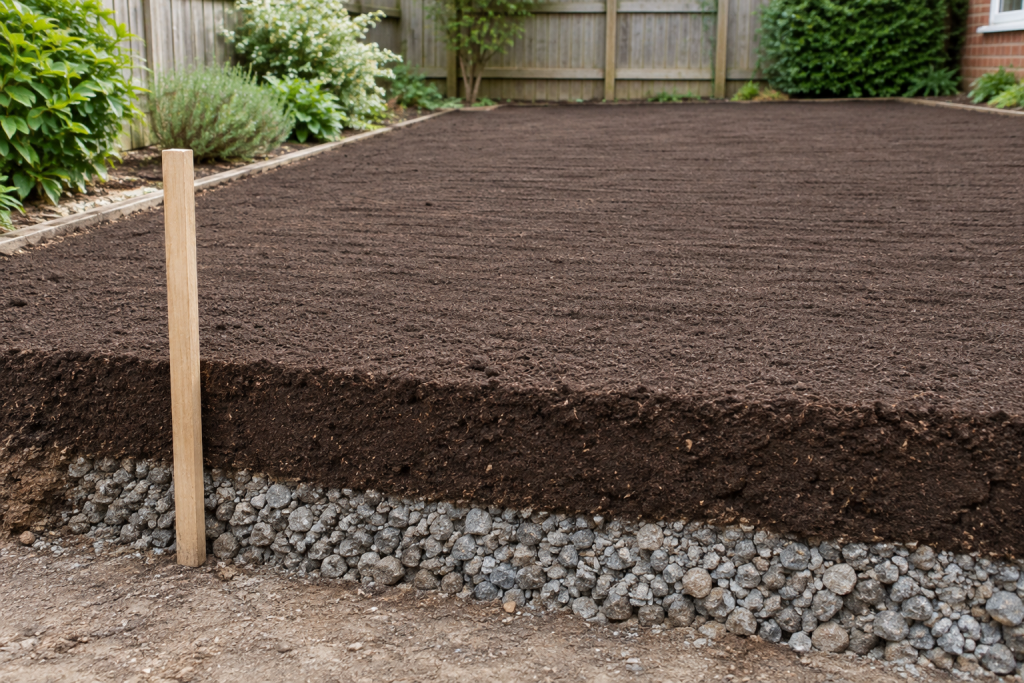
The depth that works: 6 inches, with 8 where you can
Plan on 6 inches of settled topsoil over the base, and go to 8 inches if the grade allows. Penn State Extension's Ask Extension answer calls 4 inches the absolute minimum for growing grass over gravel, recommends 6, and describes 8 as ideal. Colorado State Extension treats 6 inches of prepared soil as the root zone for a healthy lawn.
Depth by depth:
– 1.5 to 3 inches: grass germinates in spring, then browns or dies when summer heat arrives.
– 4 inches: marginal. Grass establishes, but roots hit the base and the lawn depends on regular irrigation.
– 6 inches: the standard target.
– 8 inches: the best choice over crushed concrete or limestone, and the most forgiving in a hot summer.
These numbers are settled depths, measured after the soil has been firmed and watered in, not the depth of a freshly dumped pile.
The seed itself only goes about 1/8 to 1/4 inch deep. The depth discussed here is the root zone underneath it.
Skip the contractor's 2-inch shortcut. In the Ask Extension case, a homeowner was told 1.5 inches was enough over gravel. The extension specialist agreed the seed would sprout, but said the plants die the moment it turns hot or dry, because there's no root system to support them.
Why thin soil over stone fails
Roots stop at compacted stone, so a thin layer caps how much water and nutrition a plant can reach. Shallow soil also heats and dries quickly, and hot rock beneath it makes things worse. That's why a lawn can look fine in May and crispy in July.
There's a drainage problem too. Fine soil sitting directly on coarse stone doesn't drain freely, because water held by the small soil pores won't move into the large stone voids until the soil above is saturated. In a thin layer this creates a soggy, perched zone after rain, then a rapid dry-out in sun. A deeper layer buffers both swings, which is one more reason 6 to 8 inches beats 4.
Prepare the base before any soil goes down
First work out what you have: loose gravel, a tightly compacted aggregate base such as crusher run, or buried rubble. Pull out large lumps of brick and concrete. If the base is compacted, fracture the top few inches with a pick, ripper tooth or tiller so water and roots aren't stopped at a hard boundary. Rubble left buried can also settle unevenly later, leaving dips and wet patches over the lumps.
Crushed concrete and limestone bases deserve extra care. They can leach lime and push soil pH above the 6.0 to 7.0 range grass prefers, which locks up micronutrients and causes iron chlorosis, a yellowing of the blades that nitrogen doesn't fix. Use the full 8 inches over these bases, test the pH after the soil is down, and add elemental sulfur if it reads high.
Landscape fabric is the usual debate. Fabric keeps topsoil from washing into open stone voids, but directly under shallow soil it can act as another barrier for roots. Use it only with 6 to 8 inches of soil above it. With less, skip the fabric and fill the surface voids with coarse sand or stone dust instead. That's the approach I'd take.
Ordering enough soil and spreading it
Topsoil typically settles 10 to 20 percent after spreading and watering. For a settled 6 inches, spread about 7 to 7.5 inches loose. For a settled 8 inches, spread roughly 9.5 to 10 inches.
For scale, one cubic yard covers about 324 square feet at 1 inch deep, so 100 square feet at about 10 inches loose (for 8 settled) needs roughly 3 cubic yards. A topsoil calculator such as the one at WeGravel will do the math for your exact area.
Buy screened sandy loam with about 3 to 5 percent organic matter. Avoid unfinished compost, which breaks down and sinks, leaving the surface uneven.
Firming, seeding and watering
Firm and level the bed by walking it or using a roller, then sow on the surface and rake lightly so seed sits no deeper than 1/8 to 1/4 inch. Roll once more for seed-to-soil contact and cover with a thin layer of straw. If you could only manage 4 inches, plan on regular irrigation through the first summer and beyond.