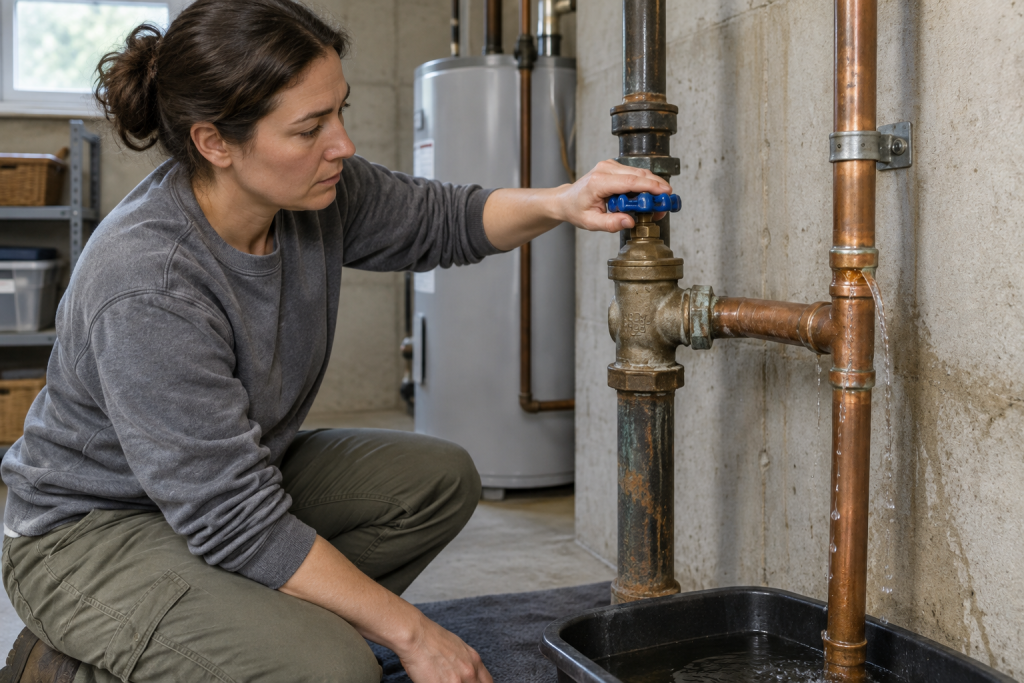
Stop the water first, then decide how serious this is
Shut the main valve before anything else. Then open the lowest faucet in the house. That drains the pipes and relieves the pressure still pushing water at the break. If you plan to drain the system, turn off the water heater's heat too, so the element or burner doesn't run dry.
Once the water is off, size up the damage. A single pinhole or one failed joint is usually a small repair. Several leaks, a break inside a wall or under a slab, or a house plumbed in an old problem material means a bigger job.
After a hard freeze, don't stop at the visible split. Ice blocks the pipe, and pressure builds between the ice and the nearest closed fixture. The pipe often ruptures several feet from the ice itself, so check the whole run up to that closed valve or faucet.
Clamps and epoxy buy time; a cut-out repair fixes the pipe
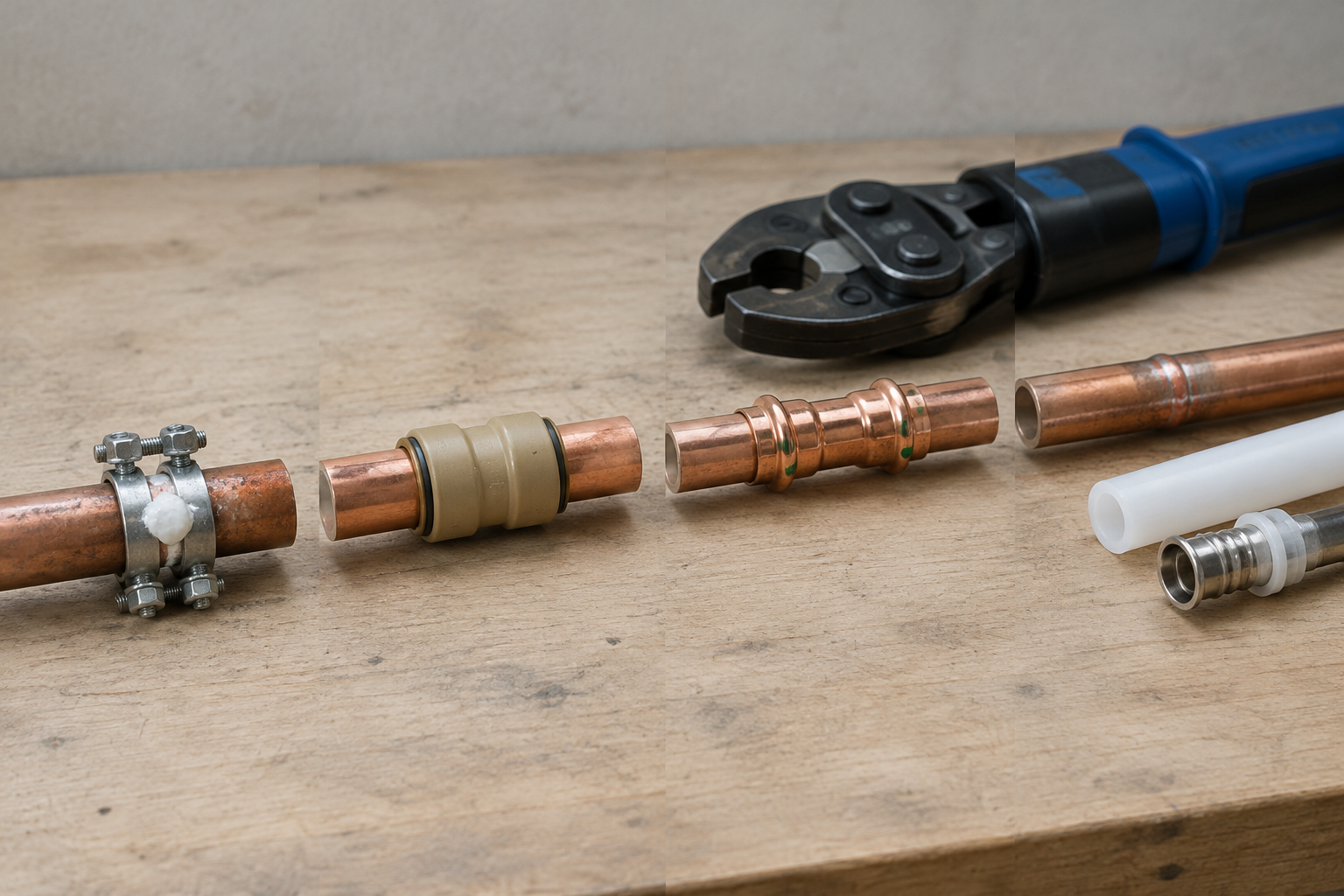
Split-sleeve repair clamps and epoxy putty are temporary stabilization, and inspection departments treat them that way. A clamp will get you through the night. I'd put one on, then schedule the real repair within days.
The lasting fix is to cut out the damaged section and couple in matched material. Model plumbing codes expect repairs to restore the line with listed fittings, and a wrapped clamp doesn't meet that. Four permanent options exist, and the right one depends on the pipe and how wet it is:
– Soldered copper is the traditional choice, but it needs a dry pipe. Water boils at 212°F and solder needs roughly 400°F to 500°F, so even a weeping valve upstream can make a clean joint impossible. Mechanical plugs or properly draining the line are the usual answers.
– Press fittings crimp onto copper with a sealing ring, work on wet or dry pipe, and skip the open flame. The catch is the press tool, which you'd have to rent or own for a one-time repair.
– PEX joints use expansion rings (PEX-a) or crimp and clamp rings over barbed fittings (PEX-b). The barbed style narrows the inside diameter slightly.
– Push-to-connect couplings need only a cutter and a deburring tool. They're code-approved, with strings attached, covered next.
If the pipe won't stay dry, I'd reach for a press fitting or push-fit coupling rather than fight a joint that won't take solder. If it's dry and you can solder, soldering is cheap and proven. Either way, use lead-free fittings, solder, and flux. Federal rules cap lead in anything that touches drinking water.
Push-fit fittings work when the prep is right, and plenty of failures trace back to prep
Push-to-connect couplings meet the ASSE 1061 standard, and the SharkBite installation guide rates them for 200 psi and 200°F. That's more than a home supply line needs. The leaks people complain about online usually trace back to how the pipe was prepared.
Burrs and scratches are the repeat offenders. A rotary cutter leaves a rough edge on copper that can slice the rubber O-ring inside the fitting as the pipe goes in. Coarse sandpaper can cut grooves along the tube that let water slip past the seal. So cut square. Deburr the end with a proper tool. Clean the tube lightly. Then mark the insertion depth with a pencil, so you can confirm the pipe bottomed out.
Placement matters too. Many plumbers won't bury a push-fit joint inside a closed wall or ceiling, and some local codes require an access panel for them. I'd follow that caution even where the code allows concealment: if the O-ring or the insertion ever fails, you want to see it before the drywall does. Check with your local building department, and put the coupling where you can reach it.
Match the repair to the pipe: copper, PEX, CPVC, polybutylene, galvanized
Copper is the pipe most homeowners are repairing, and the first question is why it failed. A freeze split looks like a lengthwise tear or a blown-out joint. A pinhole is different: corrosion has eaten through the wall from the inside. Water chemistry gets most of the blame, and water utilities point to chloramines and aggressive water. Acid flux left inside the tube from the original soldering can also start pitting. One pinhole can be cut out and repaired like any other leak. Several mean the pipe is wearing out everywhere, so price a replacement of the run before you chase the next leak.
Aged CPVC is the material I'd handle most carefully. It turns brittle after years of heat and chlorinated water. Plumbers say ratchet or scissor-style cutters can crack old CPVC lengthwise well past the cut, which turns a small valve repair into a drywall job. I'd skip ratchet cutters on old CPVC and use a fine-toothed saw. If the pipe cracks easily in your hands, the whole system is probably near the end of its life.
Polybutylene, the gray plastic common in homes from roughly the 1980s and early 1990s, needs dedicated transition fittings to connect to anything else. It fails suddenly and has been withdrawn from modern codes, so a leak in polybutylene is a strong reason to think about repiping rather than patching.
Where copper meets galvanized steel, codes call for a dielectric fitting or approved transition. Many plumbers prefer a short lead-free brass nipple, since dielectric unions often clog or fail with scale. A bare copper-to-galvanized joint will corrode either way.
PEX tolerates freezing better than rigid pipe because it expands, though fittings can still split. Months of direct sunlight degrade exposed PEX, so keep it covered.
When to stop DIY: the point where a plumber or a repipe makes sense
Call a professional when the leak is inside a finished wall or under a slab, when pinholes keep appearing, or when the system is polybutylene or visibly brittle CPVC. Those situations tend to hide further damage, and the repair often means opening walls and checking permit rules. Many jurisdictions expect a permit for more than a simple fitting swap, so ask your local building department first.
Pressure matters too. Plumbing codes cap static pressure at 80 psi, and higher pressure calls for a pressure-reducing valve. Repeated leaks in a high-pressure house may be a pressure problem, and no amount of patching cures that.
If you find lead or galvanized steel on the service line, the pipe from the street to your meter or house, treat it as a separate issue. The EPA's lead rule requires water utilities to replace lead service lines on their side within a set timeline, so ask your utility what it knows about your line and what your side of the connection is made of.