Start with the water: the freeze damage you can't see until spring
Most winterizing lists run room by room. I'd rank the jobs by what a failure costs you, and the most expensive failure is a pipe that splits inside a wall. You won't see it, hear it, or smell it until the water comes back on in spring.
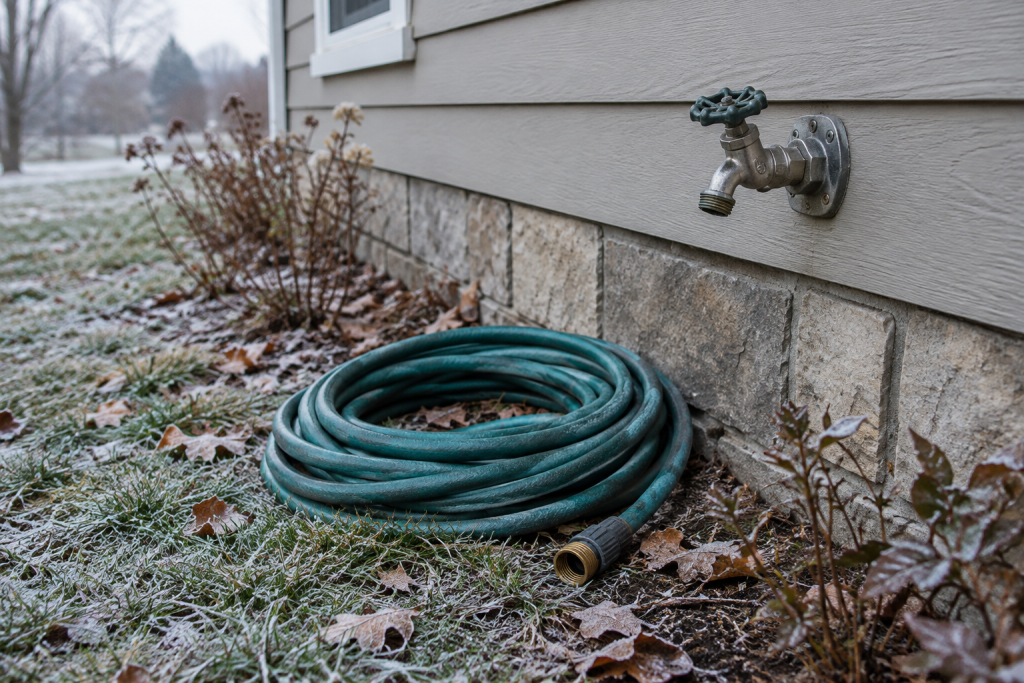
The usual way this happens is a garden hose left on a frost-free sillcock. Those faucets are built so the valve seat sits several inches inside the heated part of the house and the barrel drains downhill when the tap is shut. A hose or quick-connect fitting left on the end holds water in that barrel. It freezes and splits the tube. Some homeowners don't find out until the first spring use sends water spraying behind the drywall.
So disconnect every hose before you do anything else on this list. Drain it, coil it, and put it away. An insulated faucet cover is fine as an extra layer, but it isn't a replacement for taking the hose off.
Older or standard spigots work differently. They rely on an interior shutoff valve, and the sequence matters:
1. Close the interior shutoff valve.
2. Open the outdoor tap to empty the line.
3. Back inside, unscrew the small bleeder cap on the shutoff valve and let the leftover water drain into a bucket.
4. Leave the outdoor tap partly open for the winter.
The bleeder cap is the step people skip. Without it, a stretch of pipe between the valve and the exterior wall can stay full, and that is the stretch most likely to freeze.
For the nights when a hard freeze is forecast, a few habits help:
– Open the vanity and sink cabinet doors on exterior walls so room air reaches the pipes.
– Let the faucet farthest from where water enters the house drip at about the thickness of a pencil lead.
– Don't let the thermostat drop below 55°F, even if you're away.
If you know supply lines run through poorly insulated exterior walls, 60 to 65°F is a safer floor during a deep cold snap.
Heating system prep: furnace first, then the heat pump trap
Put a fresh filter in before the heating season gets going. If you have a high-efficiency furnace (90 percent or better), also walk outside and check the white PVC intake and exhaust pipes on the exterior wall. Drifted snow or ice over those openings can trip a safety switch and shut the furnace down, usually on the coldest night.
Thermostat advice depends on what heats your house. For a furnace, the Department of Energy says setting the temperature back 7 to 10°F for about 8 hours a day can cut annual heating costs by up to 10 percent, using roughly 68°F as the daytime baseline. A schedule that drops the temperature while everyone is asleep or at work is the easy way to get that.
Heat pumps are different, and I wouldn't copy the furnace schedule. A big overnight drop can make an older control call for electric resistance strips during the morning recovery, which cancels the savings. Keep heat pump setbacks to about 2 to 3°F unless your thermostat has adaptive recovery or a heat pump mode designed for this.
The bigger trap is the Emergency Heat setting. It locks out the compressor and runs resistance heat, which several utilities and HVAC companies put at roughly two to three times the operating cost of normal heat pump operation. It's meant for a failed outdoor unit, not for cold weather. Two things trick people into using it: air at the registers that feels cooler than furnace air, and steam rising from the outdoor unit, which is typically just a defrost cycle. My advice is to leave Emergency Heat alone unless a technician tells you the heat pump itself is down.
One more thing to skip: closing vents in unused rooms. It sounds like free savings, but duct systems are sized for a certain airflow. Shutting off a meaningful share of registers can strain the blower and push more air out through duct leaks.
Ice dams: seal the ceiling before you add insulation or buy cables
Ice dams get blamed on gutters and snow load, but the cause is usually heat. Warm indoor air leaks up into the attic, warms the roof deck, and melts the bottom layer of snow. The meltwater runs down to the cold eave, where it refreezes and builds a ridge that backs water up under the shingles.
That means the fix sits at the ceiling, and the order matters.
First, air seal. Gaps around recessed lights, chimney chases, plumbing stacks, wire penetrations, the attic hatch, and the tops of walls let conditioned air into the attic. Building Science Corporation treats stopping that leakage as the primary cure.
Second, add insulation. Attic targets generally run from about R-38 to R-60 depending on your climate zone. The part many people get wrong is doing this first. Piling insulation over unsealed leaks leaves the air paths intact and can even block soffit airflow, so the problem doesn't improve and may get worse.
Third, make sure the roof can breathe, with air moving from the soffit vents up to the ridge so the underside of the deck stays cold.
I'd skip heat cables. They can cut a channel through an existing dam, but they don't touch the heat loss that created it, and they cost money to run. A roof rake can pull snow off to relieve a bad winter, but it treats symptoms too. If dams come back year after year, the better spend is an energy auditor or insulation contractor who can run a blower-door test and find where the air is getting through.
Outdoor systems that need a pro or the right equipment: sprinklers and vacant homes
If you have an in-ground sprinkler system, hiring an irrigation company for the blowout is usually the better call. Clearing the lines takes a lot of air volume at low pressure. A small pancake compressor delivers neither enough volume nor a safe way to compensate. Manufacturers such as Rain Bird and Hunter cap pressure at about 50 psi for flexible poly pipe, and pushing harder can damage valves and rotor heads. Afterward, the handles on backflow preventer valves should sit at a 45-degree angle so no water stays trapped in the brass.
If a home will sit empty through the winter, the basic drain-down is short: shut off the main supply, turn off the water heater first so the elements don't run dry, then open faucets from the top floor down. Toilets need to be flushed and the remaining water sponged out.
Traps need antifreeze, and only the right kind. Use RV or marine antifreeze, which is propylene glycol. Never pour automotive antifreeze (ethylene glycol) into household drains, because it is toxic and can harm septic systems.
Safety checks that spike in winter
Test your carbon monoxide detectors in the fall and put in fresh batteries. Winter brings more furnace runtime, closed-up houses, and backup fuel use, and all three raise the risk.
If the power goes out, run a portable generator outdoors only, at least 20 feet from windows, doors, and air intakes. Space heaters need 3 feet of clear space around them and should plug directly into a wall outlet, never an extension cord or power strip.