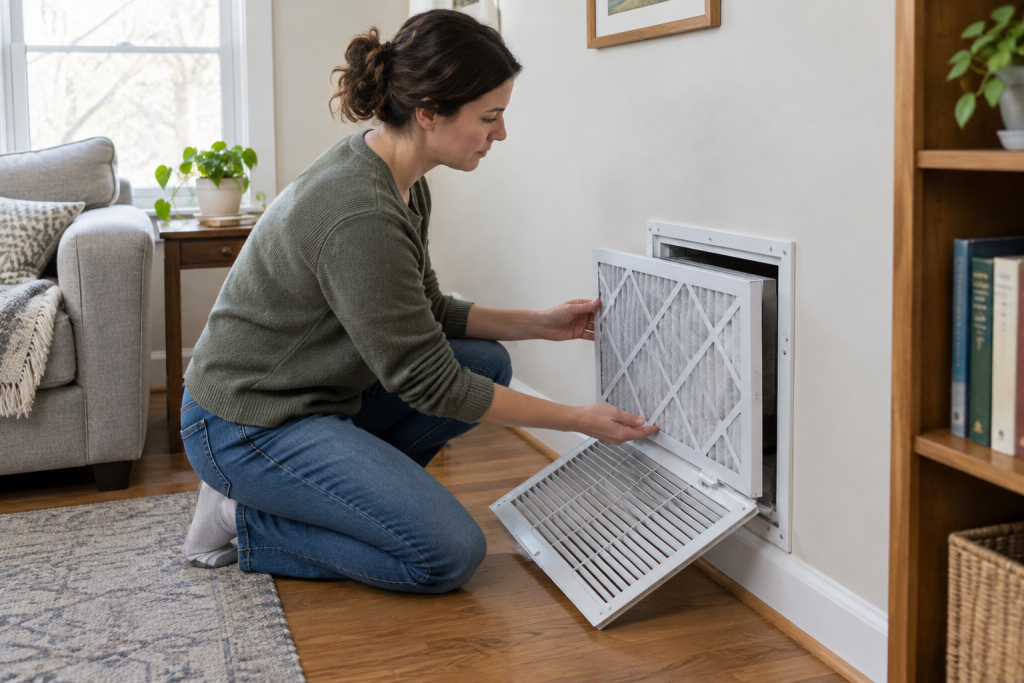
The two visits and the few chores in between
Most of HVAC maintenance is a small set of chores you can do in minutes, plus two visits from a professional. Energy Star and the Department of Energy both point to the same rhythm: a cooling check in spring, before you need the air conditioner, and a heating check in fall, before you need the furnace. The chores in between keep air moving and water draining.
Airflow is the reason this matters. The DOE says restricted airflow across coils and blowers can cut system efficiency, and that swapping a clogged filter for a clean one can lower air conditioner energy use by roughly 5% to 15%. That makes the filter the cheapest efficiency upgrade in the house.
The professional visits are where quality varies most. A quick look and a wipe-down is not a tune-up. The benchmark is ACCA Standard 4 (ANSI/ACCA 4 QM), the national consensus standard for residential maintenance. It calls for measured checks: supply and return temperature split, electrical readings compared to the nameplate, heat exchanger inspection, and safety control testing. If a tech never puts a meter or analyzer on your system, you got a glance, not the standard.
Your own calendar is short. Check the filter every month or few, flush the condensate drain monthly through the cooling season, and clear the outdoor unit in spring when the cooling check is booked. The fall visit is the heating check, and it is all the technician's.
The filter: the one chore that matters most, and the upgrade that backfires
If you only do one thing, check the filter. The usual guidance is every 30 to 90 days for a standard 1-inch filter and every 6 to 12 months for a 4-inch media filter. Use the short end of that range if you have pets, run the system constantly, or live somewhere dusty.
A clogged filter starves the system of air. On the cooling side, low airflow can drop the evaporator coil below freezing so it ices over, which is the classic reason a unit suddenly stops cooling. On the heating side, the furnace can overheat and shut down on its limit switch. Both failures are cheap to prevent and expensive to repair.
The part most people overlook is that filter depth matters as much as the MERV number. Higher MERV means finer filtering, and that sounds like a pure upgrade. But a dense filter is harder for air to pass through, and a thin 1-inch filter has little surface area to spread that resistance across.
Most residential systems are designed around a total external static pressure of about 0.5 inches of water column. Building science and DOE-related research notes that a dense 1-inch MERV 13 filter can use up a big share of that budget by itself, with a pressure drop in the range of 0.25 to 0.35 inches. That leaves the ductwork, coil, and grilles to fit in what remains.
How your blower reacts depends on its motor. An older single-speed PSC motor simply moves less air when resistance rises, which raises the risk of a frozen coil in summer or a tripped limit switch in winter. A variable-speed ECM motor tries to hold its programmed airflow by working harder, which raises power draw and heat in the motor's control module and can shorten its life. Technicians say they often find a dense 1-inch filter in the slot when they replace a failed variable-speed blower motor. That isn't proof of cause, but it matches the mechanism.
I'd stay with MERV 8 in a standard 1-inch slot unless someone has measured your static pressure and confirmed there's room. MERV 8 catches the dust, lint, and pollen that matter for protecting the equipment, and it lets the system breathe.
If you want finer filtration for allergies or smoke, don't force it into the thin slot. The better fix is a deeper media cabinet that takes a 4 or 5-inch filter. The extra pleated surface area lowers the resistance, so you can run MERV 11 to 13 without choking the blower. It costs more up front, and it also means changing the filter only a couple of times a year.
One more habit to check: the arrow on the filter should point toward the blower, and the filter should never be left out. Dust that bypasses it ends up on the coil and in the drain pan, which feeds the next problem.
The condensate drain: a ten-minute summer habit that prevents mystery shutoffs
Your air conditioner pulls a lot of water out of the air, and that water leaves through a drain line. Dust and moisture feed algae slime in the pan and trap, and eventually the line clogs. Building codes call for a backup, either a secondary drain or a float switch. When water rises, the float switch cuts the control circuit and the AC shuts off instead of flooding your ceiling.
That's why a system that quits on humid afternoons, then works again later, is worth a look at the drain before anything else.
The routine is simple. Once a month during cooling season, pour about a half cup of distilled white vinegar into the drain access, wait a bit, then flush with warm water. Treat the half cup as the common recommendation, not a precise spec.
I'd skip bleach. Carrier and Trane both steer homeowners toward vinegar, and bleach can degrade plastic drain components and PVC joints over time. A wet/dry vac on the drain outlet is for an actual clog, not for routine care.
Outdoor unit care: clear it, rinse it gently, and don't wrap it
Keep about 2 feet of clear space around the condenser. Trim plants, rake leaves away, and keep mulch and clutter off the sides, because the unit needs to move air through its coil to shed heat.
If the coil is dusty, rinse it gently with a garden hose from the inside out, so you push dirt out the way it came in. I'd skip harsh foaming coil cleaners. Caustic or acidic products can strip protective coatings and weaken the bond between fins and tubes. If you ever use a chemical wash, it should be pH-neutral and labeled for residential coils.
The winter habit I'd stop is wrapping the whole condenser in a fitted cover. A full cover can trap moisture against the coil and electrical compartment and give rodents a sheltered spot to nest. If falling debris worries you, lay a board or a top-only cover over the fan opening, weight it down, and leave the sides open.
What a technician should check, and when to call one
Some work should not be DIY, and a few of the reasons are about safety rather than convenience.
In spring, the cooling check should cover the electrical parts and the refrigerant circuit. Dual-run capacitors are rated in microfarads, and manufacturers commonly allow a tolerance of about 5% to 6%. A capacitor outside that range can still let the unit run, but it raises motor temperature and amperage and can lead to a burned-out fan or compressor motor. Capacitor failure is among the most common air conditioner repairs, so it's worth having measured before July. The tech should also inspect the contactor for pitting or debris and check the refrigerant charge. Refrigerant work requires EPA 608 certification, so that part is not a homeowner job.
In fall, the heating check is mostly about combustion. The tech should clean and inspect the burners, check the flue and draft, and inspect the heat exchanger, ideally with a combustion analyzer and a camera. A cracked heat exchanger can leak combustion gases into the air your blower distributes.
Don't count on a household carbon monoxide alarm to cover for this. Standard alarms are built not to sound at low levels, and the common threshold involves sustained exposure at around 70 ppm for an hour or more. A combustion check can catch problems well below that.
Newer equipment adds another layer. Residential systems made from 2025 onward use mildly flammable A2L refrigerants such as R-454B and R-32, and they include leak sensors. Servicing them takes specific tools and training, which makes it more specialized than older R-410A work. If you have one, ask whether the company is set up for it before booking.
Between visits, call a pro if any of these show up:
– Ice returns on the coil after you've put in a clean filter
– The system shuts off repeatedly, and the drain isn't the cause
– You smell burning or exhaust from the vents or furnace
A new filter or a vinegar flush won't fix any of those.